


International Day of Photonics: Where Light Makes the Future Possible
21 October – Photonics powers many of the technologies shaping our world. But whether light is used to transmit information with precision, reveal the tiniest structures or create immersive visual experiences, optical quality is what makes the difference.
Light is far more than what we see. As a carrier of information, a precision tool and a precisely controllable source of energy, it underpins numerous key technologies – from semiconductor manufacturing and optical communications to augmented and virtual reality.
On 21 October, we celebrate the International Day of Photonics. The date commemorates 21 October 1983, when the General Conference on Weights and Measures adopted the value of the speed of light as exactly 299,792,458 metres per second. This decision was an important milestone in the modern definition of the metre and symbolises the importance of precise measurement in photonics. Today, the international awareness day highlights the potential of light-based technologies around the world.
Three Applications. One Common Challenge: Optical Quality.
Whether light is used to inspect the finest structures, transmit data across vast distances or display digital content, overall system performance depends largely on the precision of its optical components. Imaging aberrations, misalignment and wavefront distortions can all compromise system performance.
This is where Optocraft’s optical metrology solutions come in. Our Shack-Hartmann wavefront sensors and specialised test systems enable the characterisation, alignment and quality assurance of optical systems throughout development, production and industrial applications.
Semiconductor Manufacturing: Optics for Precise Wafer Inspection
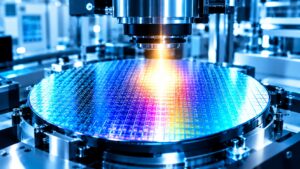
In wafer inspection, complex optical systems must reliably image even the finest structures. High and reproducible imaging quality is therefore essential. Our SHSInspect test systems enable comprehensive characterisation of lithography objectives. They measure parameters including transmitted wavefront and focal length, as well as imaging metrics such as PSF and MTF. In addition, wavefront sensors can be used to precisely align optical systems and identify misalignment.
Discover our solutions for lithography and wafer inspection
Free-Space Optical Communication: Transmitting Data Across Vast Distances with Light

In optical communication between ground stations and satellites, information is transmitted using laser light. To ensure that signals reliably reach their destination, optical transmitters and receivers must be precisely designed, aligned and tested. The SHSLab wavefront sensor provides valuable measurement data for assessing optical quality and precisely aligning transmission optics. Combined with adaptive optics, wavefront measurements can also help correct laser beam distortions caused by atmospheric effects.
Discover our metrology solutions for space applications and free-space optical communication
AR/VR/MR: Optical Precision for Compelling Visual Experiences

In augmented, virtual and mixed reality, the quality of optical components determines how sharp, colour-accurate and comfortable digital content appears to the user. Even minor deviations can cause double images, distortion or other visible artefacts. Optocraft wavefront sensors enable the precise testing and alignment of lenses, pancake optics and other optical systems. The resulting measurements reveal imaging aberrations and provide a sound basis for targeted optimisation of optical performance.
Discover our solutions for AR/VR optics
Optical Quality Makes the Difference.
These three applications demonstrate the versatility of photonics – and what connects them: light can only fulfil its full potential when it is precisely controlled. Optocraft makes optical quality measurable, helping manufacturers develop, align and test demanding optical systems with confidence.
On the International Day of Photonics, we celebrate not only the possibilities of light, but also the precision that turns those possibilities into high-performance technologies.